
Beginner's Guide
What is Pickleball?
A paddle sport combining elements of tennis, badminton and ping-pong - and completely addictive.
The 30-Second Explanation
Pickleball is a paddle sport that combines elements of tennis, badminton and table tennis (ping-pong). It's played on a compact court - about a third the size of a tennis court - with a solid paddle and a lightweight perforated plastic ball. The game can be played as singles or doubles, indoors or outdoors, and suits all ages and abilities.
What makes pickleball unique is its simplicity. The rules are easy to learn, the underhand serve removes power as a barrier to entry, and the 'kitchen' (non-volley zone) keeps rallies long and strategic. Most beginners are playing competitive points within their first session. That accessibility - combined with genuinely engaging gameplay - is why pickleball is now the fastest-growing sport in the world.
Why Pickleball is Booming in Australia
Australia has embraced pickleball faster than almost any country in the world. Participation has grown exponentially year-on-year, with dedicated pickleball venues, converted tennis courts, and pop-up events now operating in every capital city and many regional centres. The sport appeals to Australians' love of outdoor activity, social sport, and friendly competition - whether you're a retired tennis player looking for lower-impact rallies, a young athlete chasing a new competitive outlet, or a family looking for something everyone can play together.
Easy to Learn
Most beginners can rally within 15 minutes. The smaller court and underhand serve make it far more approachable than tennis.
Incredibly Social
Doubles on a compact court means you're always close enough to chat, laugh and trash-talk - it's the most social sport going.
Great Exercise
Players burn 400-600 calories per hour. It's low-impact on joints but high on cardio, making it suitable for all ages and fitness levels.
Competitive Depth
From casual social sessions to club leagues and the NPL - there's a competitive pathway for every skill level.
How Pickleball is Played
Pickleball has a handful of simple rules that make it easy to pick up but endlessly strategic at higher levels. Here are the key concepts you need to know — or read the full pickleball rules guide for serving, scoring and the kitchen in detail.
How Pickleball Scoring Works
Scoring is the part that confuses every new player. It takes about two games to click - here it is in four steps.
- 1
Only the serving side can score
If the receiving side wins the rally they do not get a point - they get the serve (or a side out). That's why games can swing quickly once a team strings rallies together.
- 2
Call three numbers, in order
In doubles you call your score, then the opposition score, then whether you are the first or second server: '4-2-1'. Every game starts at '0-0-2', because the first serving team only gets one server before handing over.
- 3
Both partners serve before a side out
When the first server loses a rally, the serve passes to their partner. When the second server loses a rally, the serve goes to the other team. Serving partners switch sides of the court after each point they win.
- 4
Games to 11, win by 2
Standard games are first to 11 with a two-point margin, so 12-10 or 15-13 are common finishes. Matches are usually best of three. Some league and tournament formats use rally scoring or games to 15 or 21 - always check the event format.
Pickleball Court Dimensions and Specifications
Official measurements used across Australian clubs, tournaments and the NPL. Handy if you're marking out a court or converting a tennis court.
| Measurement | Official size |
|---|---|
| Court size | 13.41 m x 6.10 m (44 ft x 20 ft) |
| Non-volley zone | 2.13 m from the net |
| Service court | 4.57 m x 3.05 m |
| Net height | 91.4 cm at posts, 86.4 cm centre |
| Total playing area | 18.3 m x 9.1 m recommended |
| Ball | 74 mm diameter, 22-26 g |
Common Faults
A fault ends the rally. If your side is serving you lose the serve; if you're receiving, the other team scores.
- Serving into the net, out of bounds, or into the wrong service court
- Failing to let the serve and the return bounce (the two-bounce rule)
- Volleying while standing in - or falling into - the non-volley zone
- Hitting the ball out of bounds or into the net
- Letting the ball bounce twice before returning it
- Touching the net, posts or opponent's court while the ball is live
Pickleball Glossary: Terms Explained
The words you'll hear courtside in your first month of playing.
- Dink
- A soft shot from near the kitchen that lands in the opponent's non-volley zone.
- Third-shot drop
- The serving team's soft third shot, used to neutralise the returners and get to the kitchen line.
- Kitchen
- Nickname for the non-volley zone, the 2.13 m strip either side of the net.
- Erne
- A volley hit while jumping around, or standing outside, the kitchen beside the net post.
- ATP
- Around the post - a legal shot that travels outside the net post, below net height.
- Stacking
- A doubles formation where partners line up on the same side so each stays on their stronger wing.
- Side out
- Loss of serve by both partners, handing the serve to the opposition.
- Poach
- Crossing in front of your partner to intercept a ball intended for them.
- Reset
- Taking pace off a hard drive so the ball lands softly in the kitchen and neutralises the attack.
- Banger
- A player who drives almost every ball hard rather than playing the soft game.
Equipment You'll Need
Shop NPL GearGetting started is affordable. All you really need is a paddle and a ball - most venues provide both for beginners.
Paddle
Made from composite, graphite or carbon fibre. Larger than a table-tennis bat, smaller than a tennis racquet.
Ball
A perforated polymer ball. Outdoor balls have 40 small holes; indoor balls have 26 larger holes for better control.
Net
91.4 cm high at the sidelines, 86.4 cm at the centre - slightly lower than a tennis net.
Shoes
Court shoes with lateral support are recommended. Tennis or volleyball shoes work well.
How to Start Playing Pickleball
You don't need gear, a partner or any experience. Here's exactly how a first session works in Australia.
- 1
Find a session near you
Most venues run beginner or open-play sessions where paddles and balls are supplied. You don't need a partner - players rotate on and off court. Use the NPL venue finder to see courts, session times and booking links in your city.
- 2
Turn up in what you'd wear to the gym
Shorts or a skirt, a t-shirt, and court shoes with lateral support. Bring water and a towel. Avoid running shoes if you can - pickleball involves a lot of side-to-side movement.
- 3
Learn the two-bounce rule first
The serve must bounce, and the return must bounce, before anyone volleys. Get that right and the rest of the game follows naturally.
- 4
Get to the kitchen line
The team that gets to the non-volley zone line first usually wins the point. Beginners tend to stay back - move up after the return and you'll improve quickly.
- 5
Find your level
Ratings run from 2.0 (beginner) to 5.0+ (pro). DUPR is the Official Ratings Partner of the National Pickleball League, and every NPL match is DUPR-rated. Most social sessions are split by rough skill bands so you're matched with similar players.
The NPL and Australian Pickleball
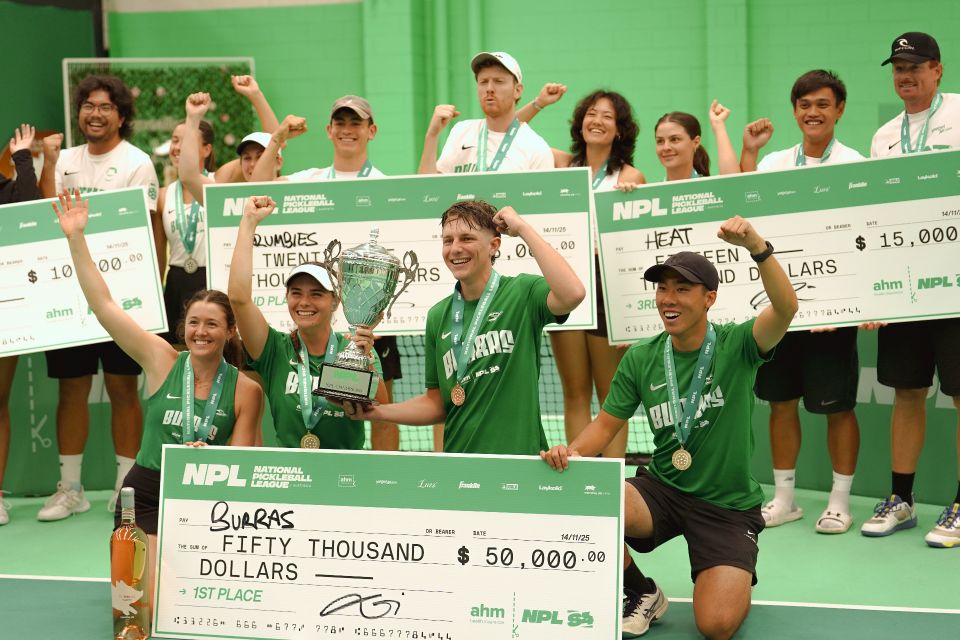
The National Pickleball League (NPL) is Australia's premier professional pickleball competition. Launched in Melbourne, the NPL brings together the country's top players across 12 franchise teams in three state conferences competing in a structured season format - complete with live-streamed matches, DUPR-rated athletes, and a prize pool that grows every season.
Beyond elite competition, the NPL is building the infrastructure for pickleball to thrive at every level in Australia. From powering dedicated venues and grassroots programs through to the NPL Academy - which develops the next generation of Australian talent - the league sits at the centre of the country's pickleball ecosystem. Whether you're watching from home or picking up a paddle for the first time, the NPL is your gateway into the sport.
Pickleball FAQs
The questions new players ask most often, answered for Australia.
Pickleball in your city
Start playing in Australia
Find a Court Near You
Pickleball courts are popping up right across Australia - dedicated venues, converted tennis courts, community centres, and pop-up events in every major city. Use our venue finder to locate a court near you and start playing today.